Towards org-level agent harnesses
Claude Tag has grown rapidly in Anthropic. I want to share some of the reasons for this and the behavioral shifts I’ve seen with this agent ...
📝 摘要
这篇文章由 Anthropic 的 Lance Martin 撰写,探讨了 Claude Tag(Anthropic 基于 Slack 的智能体产品)如何推动组织级智能体协作的三次核心行为转变——从单人工具演进为组织级协作基础设施。
核心概念: AI 智能体的使用范式正在从"单人附属工具"演进为"组织级协作基础设施",这需要同步→异步、被动→主动的交互模式根本性转变。
关键技术栈 / 关键要点:
- 单人→多人协作 — 从个人 Claude Code 配置转向组织级 Claude Tag(共享身份、连接器、技能),新员工即时获得同等能力,共享上下文减少工作重复
- 同步→异步工作 — Claude 任务长度每 4 个月翻倍,安全改进(抗 prompt injection、auto-mode 分类器、agent identity 安全模型)使异步委托可信;goal 原语支持自主运行+测量+纠错
- 被动→主动交互 — 异步 UX 需要主动通知,Claude Tag 通过频道级记忆(channel-based memory)使主动性可定制:实验监控、主动搜索、条件触发提醒
- HTML 交互面 — Claude 用 HTML dashboard/可视化传达大量实验性或数据科学工作结果
- 多面互补 — Claude Tag 适合发起工作,CLI 适合需要手动操控的后续任务,二者互补而非替代
关键结论 / 实践建议: 组织级智能体 harness 的成功依赖三大条件——模型长任务能力、安全信任机制、以及新的交互原语(如 goal、频道记忆);建议从团队公共频道开始试点异步+主动模式。
Claude Tag has grown rapidly in Anthropic. I want to share some of the reasons for this and the behavioral shifts I’ve seen with this agent UX.
Single to multi-player
When I joined Anthropic, nearly everyone had their own Claude Code harness with personal connectors. Agent identity was tied to the individual.
Over the past few months, Claude Tag introduced an org-level agent harness, giving Claude its own identity, connectors, and skills within Slack.
I saw this give rise to a number of benefits.
First, I think it helped to level the playing field of contributions. For example, new employees have immediate access to the same harness as everyone else, which helps people onboard more quickly.
Second, a harness with access to shared context, such as public channels in defined security boundaries, has benefits like reducing work duplication and disseminating best practices.
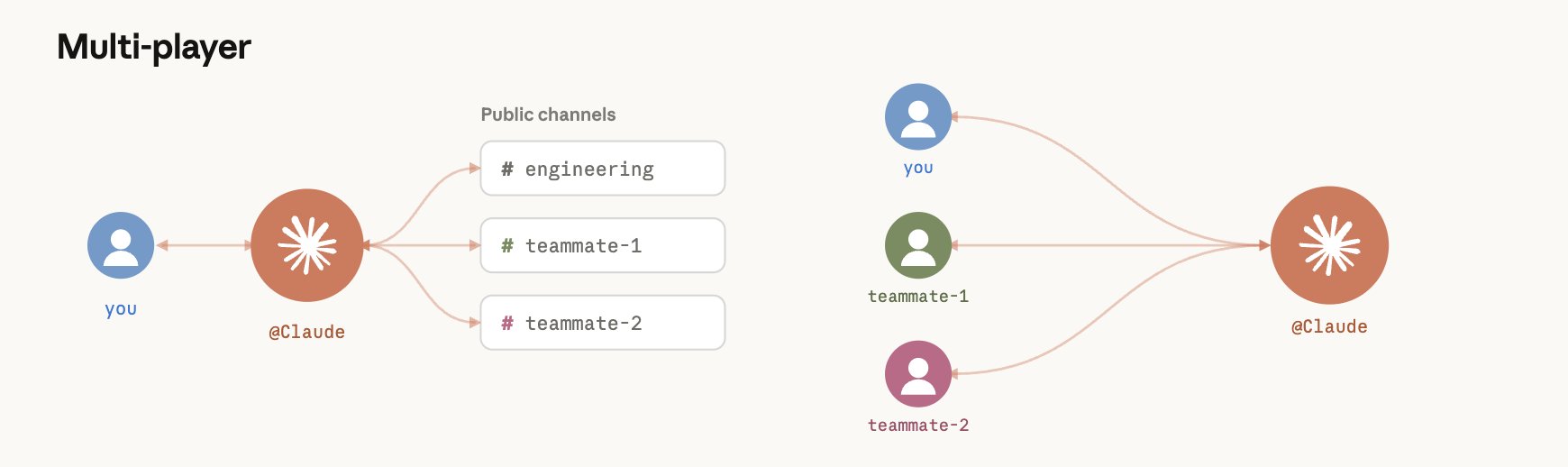
Finally, org-level harnesses open up different types of multi-player work coordination. Claude works “inline” with teams on problems such as:
- Incidents are posted to a Slack channel and @Claude helps investigate the root cause with multiple engineers in a shared thread
- @Claude is tagged in a long discussion thread to write a postmortem with timeline and actions.
Synchronous to asynchronous
Like many, I've built Slackbots before. When Claude could only manage a limited amount of autonomous work, I needed to steer the bot with regular check-ins, nudges, and approvals.
In the past, the model capability didn't support a smooth asynchronous agent UX and I often found myself just returning to Claude Code in the CLI.
One way to think about product surfaces over time: Claude is a light source and the product is the lens that focuses it. As Claude gets more capable, the right product lens changes.
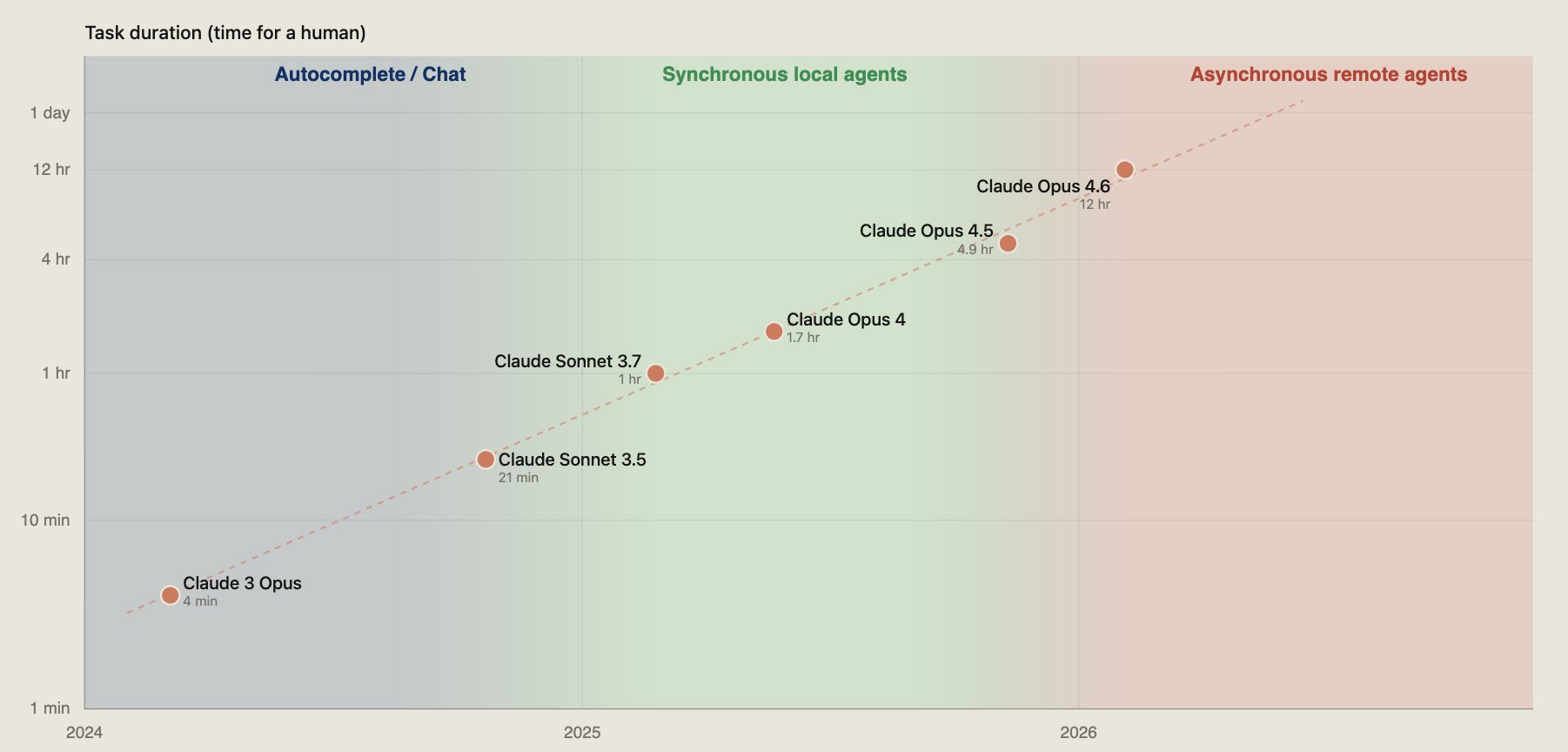
With Claude's task length doubling every four months, Claude Tag became an increasingly appealing product surface.
Of course, this was due to model capability. But, security improvements also made it possible to trust asynchronous work delegation.
Claude got more resistant to prompt injection, classifiers (auto-mode) could review actions, and Claude Tag developed a strong security model.
Asynchronous work in Claude Tag also paired well with new primitives, like goal, that let Claude run, measure against the goal, and self-correct:
- "Find opportunities to improve latency, check results, and profile."
- "Migrate framework X→Y across the code. Verify each migration e2e."
Long-horizon work also pairs well with the shift towards HTML as a communication surface for Claude, which @trq212 wrote about here.
I’ll often have Claude communicate a large body of experimental or data science work with a custom HTML dashboard and visualizations.
Reactive to proactive
An asynchronous UX often needs Claude to come to you: if Claude runs for six hours and gets stuck, I want a proactive alert.
But proactivity preferences are task- or user-specific. Claude Tag makes this highly steerable with channel-based memory.
Memory is an important unlock for this UX, because it allows Claude to capture and remember your preferences for proactivity.
@trq212 mentions some examples here: give Claude Tag channel-specific response preferences (e.g., always respond, respond to specific request type) or just tell it specific triggers (e.g., a schedule or event-driven).
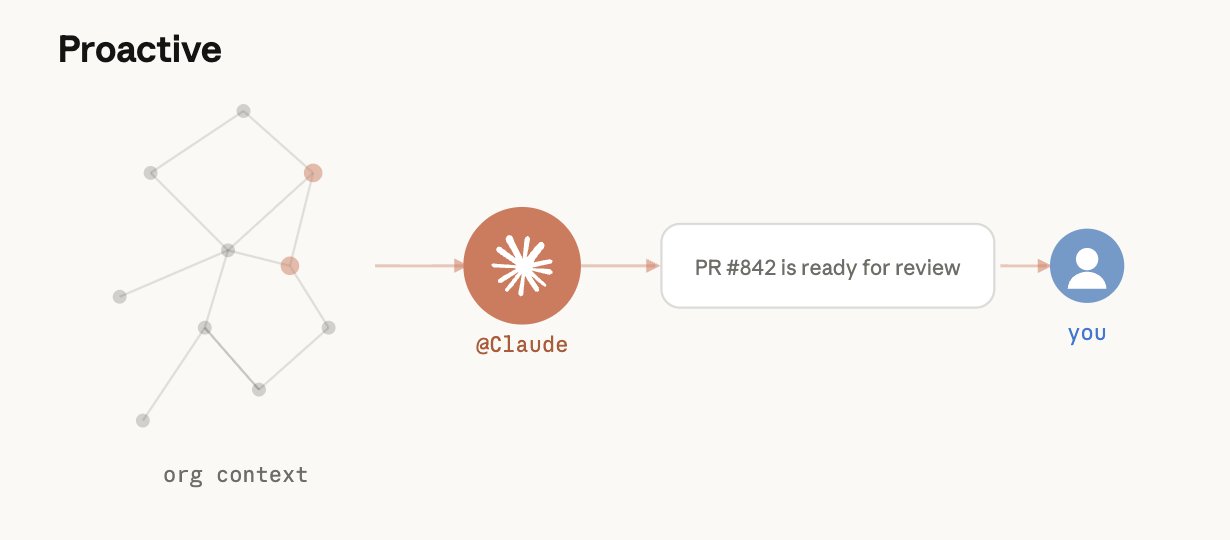
There are a few places where I use this:
- Experiment monitoring: @Claude monitors a long running experiment and proactively helps to keep it running.
- Proactive search: @claude proactively searches channels so that I understand prior work and best practices before starting on a task.
- Channel watcher: I’ll tell @Claude to "ping me if < some condition is met >”. Claude will @-mention me under these conditions.
Claude Tag should be thought of as an org-level agent harness, with Slack being just the first of several surfaces.
It is enabled by a combination of factors, including Claude's capacity for long-horizon tasks and various security-related improvements.
It also unlocked a number of new interaction patterns such as multi-player, asynchronous, and proactive use of Claude.
Finally, it’s complementary with other surfaces for Claude Code, such as the CLI. I often use Claude Tag to initiate work, but follow-up in the CLI for certain tasks that require a more hands-on UX.
To learn more, check out these resources: