Loop Driven Development, in practice
In Loop Driven Development I made an argument: when coding agents do the implementation, the engineering that matters moves to the feedback ...
📝 摘要
本文是 Loop Driven Development(LDD)方法论的实战案例,作者 @nfcampos 通过两个长时间 Claude Code agent session,构建了一个公开的 xlsx 引擎评测基准 xlsx-corpus-bench(Apache 2.0)。该基准使用 15,970 个真实工作簿(680 万公式单元格)对五个 xlsx 引擎进行评测,与真实 Excel 的计算结果逐单元格对比。
文章围绕人类在 LDD 中做出的四个核心决策展开:选择 oracle(用真实 Excel 而非文件缓存值作为真值来源)、确定测量属性(文件打开、往返保存存活、公式重算匹配,排除速度和内存等无客观标准的指标)、设计比较方式(统一比较器、统一评估集合、无争议性排除)、判断何时完成(以失败报告为工作队列、缺口归零即完成)。关键发现:281,941 个不匹配单元格中,96% 来源于测量误差(locale 不一致),真实引擎差距仅 10,604 个单元格。
核心概念: 当编码 agent 负责实现时,工程的核心转移到反馈循环设计——人类的角色是定义可信的 oracle、可辩护的度量和可验证的完成标准,agent 负责全部实现工作。
关键技术栈 / 关键要点:
- Oracle 选择 — 用真实 Excel 脚本化生成真值(
excel_truth.py+fullCalcOnLoad),排除文件缓存值的 provenance 风险 - 统一评估标准 — 所有引擎使用相同的比较器(1e-9 浮点容差 + 字符串/错误码精确匹配)、相同的评估集合(Excel 能处理的文件)
- 调试信号优先于修复引擎 — 96% 的"失败"来自测量方法错误(locale 不匹配),先修正 oracle 才能得到真正的引擎差距
- 失败报告即工作队列 — 将失败枚举为可检查的报告文件(WITAN-FAILURES.md),agent 逐项修复,缺口归零即完成
- 防御性方法论 — 每个方法论选择都偏向可辩护性,宁可少排除也不引入可被质疑的筛选条件
- 最终结果 — witan 引擎 100% 文件打开和往返存活率,99.7–99.8% 公式单元格精确匹配 Excel
关键结论 / 实践建议: LDD 的实践模板为:公开语料集作为分母、真实应用作为 oracle(一次生成、永久比对)、单一比较器/单一评估集合/无争议排除、失败报告作为 agent 工作队列、所有产出物可复现。两个长时间无人值守的 agent session 即可产出 680 万断言级别的评测基准。
In Loop Driven Development I made an argument: when coding agents do the implementation, the engineering that matters moves to the feedback loop, and the human's job comes down to four decisions — which oracle to trust, which properties to pin, what shape the comparison takes, and when the agent is done. This post walks through one real project, decision by decision, with verbatim excerpts from the two Claude Code sessions where it happened. The result is public: xlsx-corpus-bench (Apache 2.0).
Here's the first message of the session that built it:
how could we quantify what % of the ooxml spec or excel feature set our xlsx product covers, compared to alternatives, like openpyxl, libre office, aspose, epplus, closedxml etc. is this doable without fudging numbers, ie in a way that people wont question it
Notice the question isn't really about tests. It's about credible numbers. Anyone can publish a benchmark where their own product wins; the hard part is building one where the methodology holds up for readers who have every incentive to find the flaw. "In a way that people won't question it" ended up being the constraint behind most of the decisions below.
One session later I had a benchmark that runs 15,970 real-world workbooks (6.8 million formula cells) through five xlsx engines and compares every recalculated formula cell against what real Excel produces. The session ran for about 39 hours of wall clock (roughly 800 turns), most of it unattended. Two public corpora bracket the space: FUSE, 10,544 workbooks crawled from the open web — old, hostile, every producer imaginable — and SpreadsheetBench, 5,426 modern, formula-heavy workbooks from real Excel forum questions. Every number has an external denominator and a binary, automated pass/fail.
The agent built all of it: the corpus plumbing, the Excel automation, the comparators, the reports, the charts. What I contributed is the four decisions. Let's go through them one at a time.
Decision 1: which oracle
The first version of the bench measured recalculation the obvious way: open each workbook, recalculate, and compare against the values already cached inside the file. Spreadsheet files store the last computed value of every formula, so this looks like free ground truth — millions of expected values, no extra work.
I dropped it as soon as I noticed:
definition for recalculation is compared to what was in the file, or to what excel would produce, only the 2nd is valuable i think? as we dont know where the file came from, for all i know it was last edited by libreoffice or something
The problem with cached values is provenance. A workbook crawled from the open web might have last been saved by LibreOffice, by a Java library from 2009, or by a tool that never ran the calculation at all. Comparing against those caches doesn't measure "does this engine calculate like Excel"; it measures "does this engine agree with whatever last touched the file." Only the first is worth publishing.
So the harness asks Excel itself, fresh, for every file. harness/excel_truth.py stages a copy of each workbook with fullCalcOnLoad="1" injected into its
Decision 2: which properties to pin
The bench pins three behaviors per library, and the README defines each in a sentence: does the file open, does it survive open→save→reopen (where the written output also has to pass a library-neutral structural validation — readable zip, well-formed XML, all relationship targets resolve), and does recalculation match Excel. Just as deliberate is what I didn't pin: speed, memory, API design. Excel has no answer for those, so the bench makes no claim about them.
Inside those three metrics is where the human time actually went, on judgment calls that all followed the same rule: when in doubt, make the choice you'd be comfortable defending. Two examples from the transcript.
The agent proposed skipping formulas that reference external workbooks. Reasonable on the surface — the bench can't open files it doesn't have. But that's not how Excel handles them:
im not sure this is right, as there should be cached values for the external refs, which should be used by good engines to compute those formulas
Excel uses the cached values of external references it can't resolve, so an engine that does the same can be judged on those cells. Excluding them would have quietly excused real failures, and it's exactly the kind of hole a critical reader goes looking for.
Later the agent went the other way and started implementing filters that would only ever be halfway houses — incomplete exclusions that, however well intentioned, could come across as cherry-picking:
[Request interrupted by user] actually lets leave this as is, i dont want heuristics or exclusions that might be deemed dubious
One exclusion did survive, and the reason it survived is the point: it can be defended in a sentence. Some corpus files were written by generator tools that cache an empty string for formulas they never evaluated, which is indistinguishable from a genuine empty-string result. Judging an engine against those cells would count the file's staleness as the engine's failure. The comparator's docstring in harness/cached_values.py carries the full argument, and cells the bench can't judge are reported, not judged.
The same rule settled the denominator question:
when we then compute stats for each of the runners we should fully exclude files excel cant open from both numerator and denominator, we must use exact same file set for all tools being tested
This is now a load-bearing comment in harness/report.py: one universe for every tool — the files Excel itself could process — excluded from numerator and denominator of every metric, for every library. No engine gets a friendlier denominator than any other.
Decision 3: what shape the comparison takes
Per-cell, binary, equality with a tolerance. The entire comparison policy fits in one function, shared by every engine:
def values_match(a, b): """Shared comparator: numbers/bools with 1e-9 relative tolerance, strings exact, errors exact by code.""" (ka, va), (kb, vb) = a, b num_a, num_b = ka in ("n", "b"), kb in ("n", "b") if num_a and num_b: tol = max(1e-9, abs(va) * 1e-9) return abs(va - vb) <= tol if ka != kb: return False return va == vb
Numbers get a 1e-9 relative tolerance because floating-point accumulation legitimately differs between engines, and pinning the 16th digit would punish implementation order rather than correctness. Strings and error codes get exact equality, because there's no legitimate reason for #VALUE! and #REF! to disagree. And the fact that this is one function matters as much as its contents: every engine is judged by the same dozen lines.
Aggregation gets reported two ways, because they answer different questions. Percent of workbooks with zero mismatched cells is the user's question: is my file right, yes or no? Percent of all formula cells matching is the engineering signal: how much behavior is correct? A workbook with one wrong cell out of ten thousand fails the first metric and barely moves the second, so publishing both keeps either one from flattering anybody. Underneath the aggregates, every file gets a JSONL receipt, so any number in the README can be traced down to the exact cells that disagreed.
Decision 4: when the agent is done
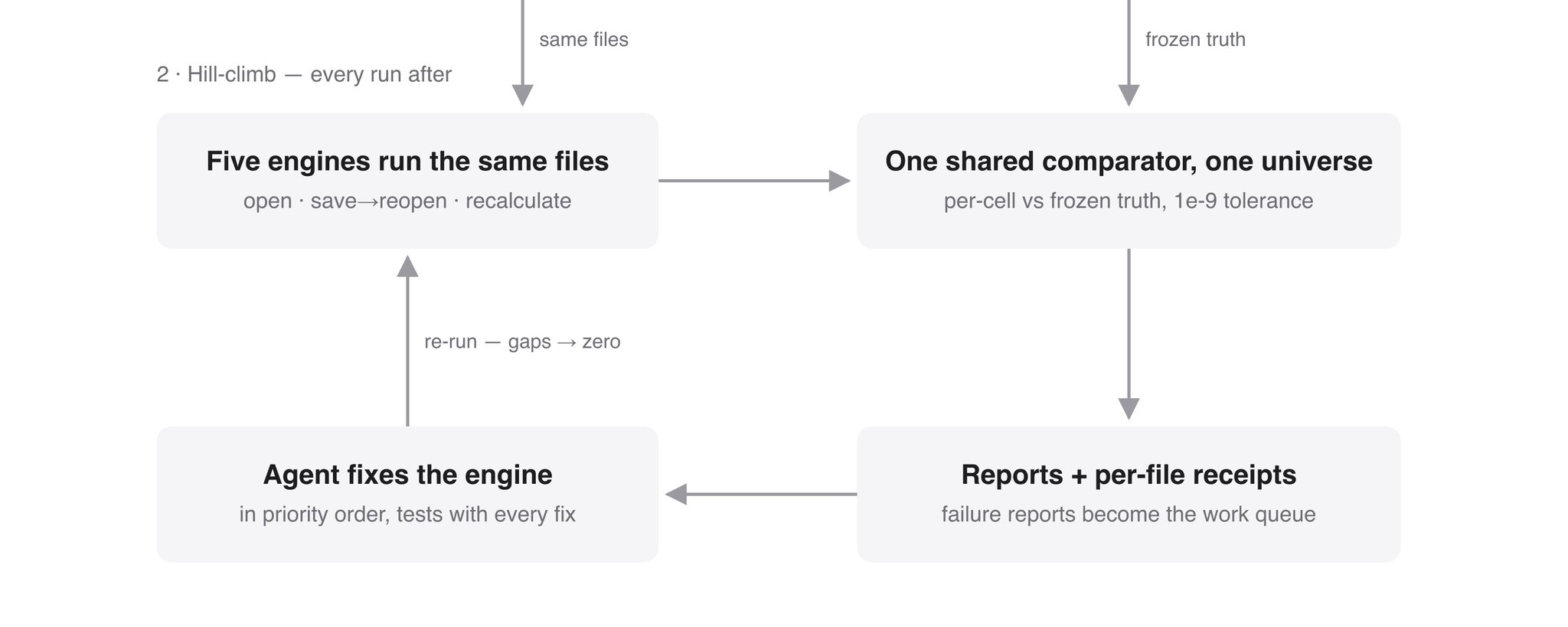
I never asked the agent to decide when it was finished. Done-ness lived in files: the bench writes its failures into checked-in reports — WITAN-FAILURES.md, WITAN-RECALC-GAPS.md — that are enumerated and prioritized. The second session, this time in the engine repo, opened by handing the agent one of them:
in a new worktree, investigate these failures ~/dev/xlsx-corpus-bench/results-fuse/WITAN-FAILURES.md report back on your findings, ideally we want to handle all of these as gracefully as possible, if need be use excel oracle
Scope was fenced explicitly, rather than trusting the agent to stop in the right place:
proceed with the others in suggested priority, start a branch for this, atomic commits, add tests as well, stop when you get to the perf tracks
And when the agent claimed a behavioral subtlety — that COUNTIFS and related functions ignore cached external-reference values where most functions use them — it didn't get taken at its word:
you've definitely confirmed with excel that countifs etc are different from most functions in that they ignore cache for external refs?
This habit is worth copying. An agent in this loop is investigator and implementer at once, and the failure mode is subtle: it reasons its way to what Excel probably does instead of asking. The fix is cheap — ask for the receipt. The oracle is right there.
Closing the loop
Everything above is the first half of LDD: producing the signal. The second session — a long one in the engine repo, working through the failure reports — is what the signal is for. It didn't go the way I expected, and the way it actually went is more instructive.
The load failures were the straightforward part. The agent worked through the checked-in report, fixed everything (it had already caught a false positive in the harness on its way in: "the harness bug is being fixed by someone else, thanks for the catch"), and the published tables now show 100.0% of both corpora opening and surviving round-trip.
The recalculation report was the interesting one. It listed 281,941 mismatched cells, and the agent's investigation collapsed them into eight root causes — of which the single biggest wasn't an engine bug at all. The bench was running the engine under a different locale than the machine that generated the Excel ground truth, and the largest "function bug" groups in the report turned out to be cascades of that one mismatch: on the order of 128,000 cells that came down to whether 31/12/2023 parses as a date. The old truth data had problems of its own and was regenerated. With the locale pinned and the truth rebuilt, the real engine gap was 10,604 cells across 235 files — about 4% of the original number. The other 96% was measurement error. The LDD post says a bad oracle is worse than no oracle because it sends work in the wrong direction; here is that sentence as 271,000 cells. Debugging the signal is part of the loop, and it has to come first.
The residual was genuine engine work, and the agent fixed it in priority order ("fix all in proposed order, do same as excel does"): lookup functions swallowing #REF! errors instead of propagating them, external-workbook references served from cache on some code paths but not others, legacy CSE array formulas, implicit intersection in pre-dynamic-array workbooks, TEXT formatting bugs down in the 1900 leap-bug region. One fix was a deliberate degradation: Excel returns #VALUE! for SUMIF/COUNTIFS over closed external workbooks even when cached values exist, so matching Excel meant making the engine strictly less useful on those cells. That's a call the oracle decision makes for you — parity is the contract, even when parity is worse — and it's also why the audit question quoted earlier got asked before the behavior was locked in.
One more thing from that session worth mentioning: it ended with two off-thread review comments on the branch — a legacy-intersection flag silently dropped when formulas move between cells, and lowercase INDIRECT column references being rejected — both valid, both fed straight back to the agent. In terms of the LDD post's feedback ranking, that's the independent-reviewer rung running on top of the oracle rung, which is where it belongs.
Where things stand, from the published tables: witan opens and round-trips 100.0% of both corpora, recalculates 95.3% of FUSE and 95.7% of SpreadsheetBench workbooks fully Excel-identically, and matches Excel on 99.7–99.8% of all formula cells. The remaining gap is enumerated in the same reports that drove the last session. That's the queue for the next one.
The recipe
Strip away the spreadsheet specifics and what's left is a template I expect to reuse:
- A public corpus as the denominator. Behaviors sampled from the wild, not authored by the team being measured.
- The real application as oracle, scripted. Frozen truth generated once, compared against forever.
- One comparator, one universe, no dubious exclusions. Every methodological choice biased toward defensibility, because the numbers are only useful if people can't question them.
- Failure reports as the agent's work queue. Done is enumerated gaps going to zero, re-verified by the same loop that found them.
- Everything pinned. Corpus, truth snapshots, comparator — even a frozen engine binary, pinned by commit, so any published number reproduces offline.
The total cost was two long agent sessions, most of them unattended. In the LDD post I argued that when oracle queries become approximately free, the equilibrium number of oracle-derived tests shifts dramatically. This is what that looks like in practice: 6.8 million assertions against real Excel, fix sessions whose work arrives pre-enumerated and pre-prioritized, and a loop that will judge every future engine change the same way it judged the last ones.
One last detail: the result charts in the README are authored and rendered by witan itself. The engine under test draws its own report card — which is fine, because the loop is what established the report card is honest.